


I homeschool my kids. I want them to think well and think differently. I workout and love when my children join in, learning to tune their bodies toward strength and health. I love nature and I think there is profound grace in merely existing in natural places. At least once a year I look at a piece of property in Nebraska, far away from the hurry of modern life, that I could buy outright with the partial equity I have in my California 900-square-foot condo.

As I watch the opening of Captain Fantastic, a man and his children reading great literature around a campfire before breaking into song together, then heading to bed in the home they built and maintain as a tightly functioning unit, I think I’m seeing a glimpse of a dream.
And there is absolutely a lot of beauty in the image.
Ben Cash has retreated with his children into the woods of the Pacific Northwest. They have no electricity. No phone. Not even an address. The plan was that he and his wife would raise them there, the way they wanted, uninfluenced by anything they didn’t want. It would be their own Utopia. But as all Utopias go, things didn’t work out. Ben’s wife suffered from issues that required her removal to a hospital far away.
Despite this guarded, literally conservative approach to the past, it becomes clear that Ben adopts and instills ideologies that actually tear down tradition. What seems like grounded aspiration toward “the good life”, and an authentic liberal arts education, dissolves into a utilitarian will to power. The oldest son, Bodevan, reveals he is a Maoist (one tenet of which is that the works of tradition must be replaced, lest the habits of tradition maintain their power1), and we realize that far from using the wisdom of the past as a lens through which to judge and navigate the present, the works of history are just words and works inside an insulated and isolated environment for the children--and one which cuts them off from the actual operation of the world. Bodevan himself admits as much.

At this point in the film, there would be a beautiful onramp to take this fear-based world of the opening act, and drive it into a place where the children’s love of literature and nature and beauty, where their love for one another and cohesion as a really large family is channeled into a truer and richer vision of what it means to live in the wider world. It does not take this opportunity. And this is where the film begins to falter (and from hereon spoilers will be present.)
The difficulty with a story in which characters aggressively challenge moral centers, either because they exist in the past or because they are ideologically incompatible with lifestyle preferences is that it makes a meaningful landing place for a story difficult to establish.
Ben Cash has a code. He has strong beliefs, and though he makes clear that he and his wife think organized religion is “the single most dangerous fairy-tale ever invented”, one might argue, “You don’t need religion to be ‘moral’.” As it turns out, for this film, you can actually ignore that philosophical question because by any reasonably acceptable standard of morality, Ben fails. Disgusted by the offerings of a restaurant (at which they were presumably going to dine and dash), they leave and execute an elaborate plan to steal all the food they want from a grocery store (including a birthday cake with which to celebrate Noam Chomsky Day). They steal the food and they celebrate. Spouting mantras like “stick it to the man,” and “power to the people”, and this after dismantling businesses run by people we have no reason to believe are any more well off than they are.
The third act could have been an atomically impactful gut punch in concluding the story of a man who desperately loves his kids and is willing to sacrifice everything for their sake. However, at his wife’s funeral—the objective destination of the story—metaphorical funeral bells begin to sound for the weight this story carries.
Ben has led his children across the country to take them to their mother’s funeral so that he and they can have closure. He has been threatened with arrest if he shows up, but even still, he defiantly enters church, steals the stage and in his eulogy states:
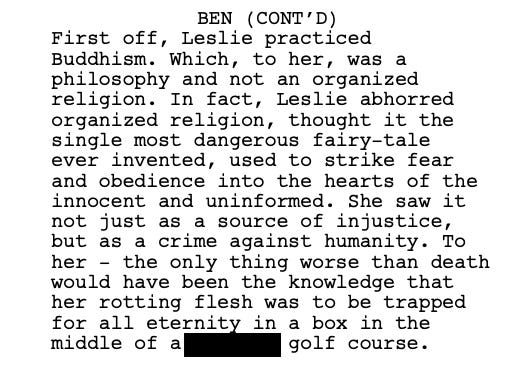
It was at this point that the film cut itself off at the knees. I have been profoundly impacted by films that take deep issue with organized religion. That is not my qualm. The issue is the insistence on the children’s mother as being nothing more than “rotting flesh.” So why’d they come? Why does this matter? Why does all of this drama need to happen? And at the end of the day the answer is, “Because Ben wants it to.” That’s it.
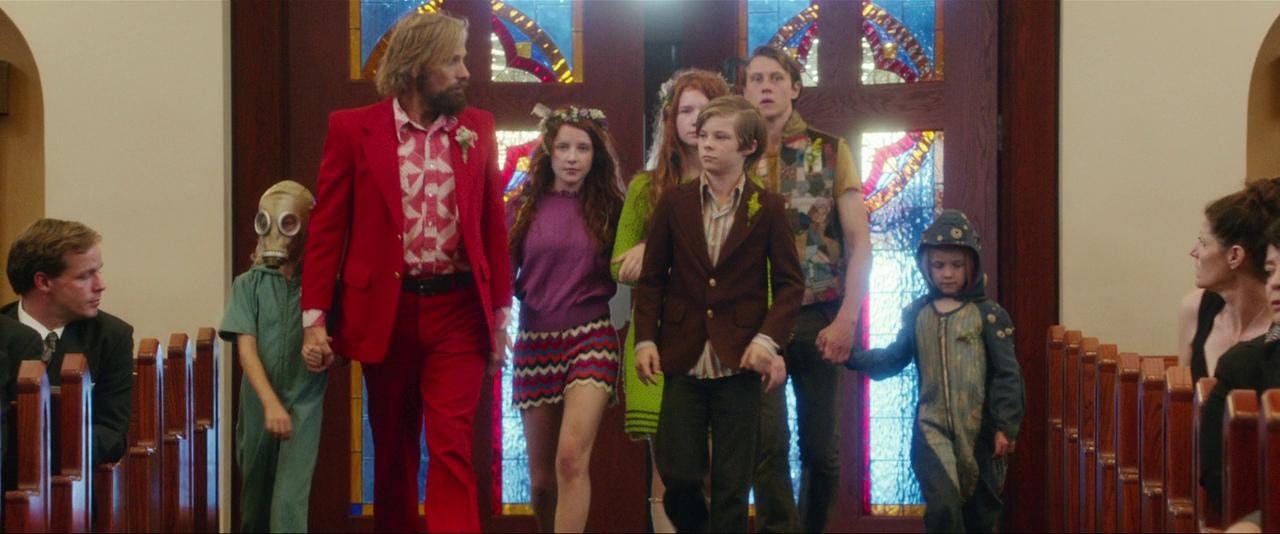
The story cannot reach beyond this point. It has torn down anything it could have reached for because the world of the film refuses transcendence.
It actually brought to mind another film that tried a similar push for impact without transcendence—Everything Everywhere All at Once. I really did enjoy that film, but after all the relentless chaos, energy and story the filmmakers attempt the line, “Nothing matters, so we have to be kind.” and my response, “WTF? Why? Why not ‘Nothing matters, so prey upon the weak. Nothing matters, so murder those who annoy you. Nothing matters, so exploit everybody and everything you can get away with.” These are all equally valid conclusions—assuming we want to allow that “validity” can even have meaning here without the ability to reach beyond the material.
Sadly, from the funeral scene on, Captain Fantastic falls into a weak sentimentality. Where else could it go? Having established that Mrs. Cash is only rotting flesh, the children continue to warmly fawn over that rotting flesh until they can burn that rotting flesh by the seaside and dump her ashes in a toilet at the airport (which was her request). Be reverent or don’t, but the attempt to do both does not land here.
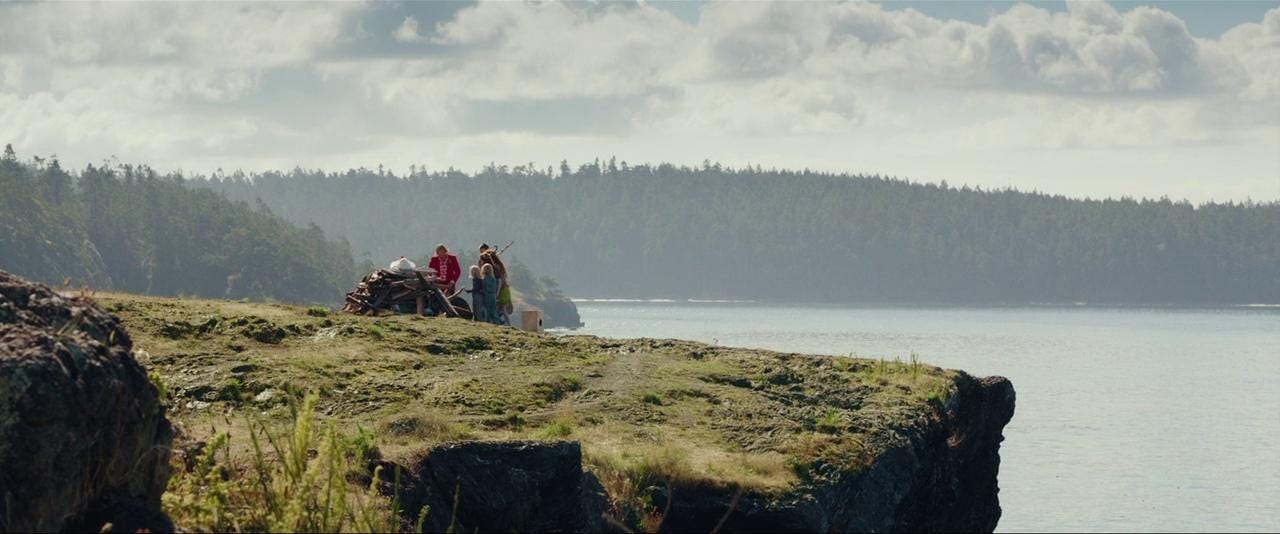
(Martin-Shaw inspired aside: I did think it deeply meaningful that the children had contact with the body of their deceased mother. We live in a culture that lives in mortal terror of death and tries to tuck away in corners and under carpets. Here Ben allows his children to mourn well and we could learn a lot from it. Transcendence is on display, whether or not the filmmakers acknowledge it.)
It is frustrating to me, because in many ways the filmmaking is astounding. The patience Matt Ross exhibits in following Ben and his struggle with how he should lead his children into the world is beautiful. The final shot of the film is a moment to live in, and Ross’ choice to cut all music and allow us to sit with the sound of the family living together is truly marvelous. But the question of “why does this matter?” looms too large in the frame for the story to have the impact it seems to want to have.
(We could also talk about Ben’s choice to have his kids attend the local public school, for which they will be so profoundly over equipped that it could have been played as a joke.)
Stories are echoes of the larger story we live in through redemptive history. You can try and live off the borrowed capital from the Old World which infused everything with Transcendent weight. But if you actively defy anything beyond the material world, you will inevitably land in the realm of the arbitrary where you can do or not do, but nothing will ever amount to anything more than an opinion.
“Decision of the Central Committee of the Chinese Communist Party Concerning the Great Proletarian Cultural Revolution.” Peking Review, vol. 9, no. 33, 12 Aug. 1966, pp. 6–11. Adopted 8 Aug. 1966.
Exceptional—thank you.