

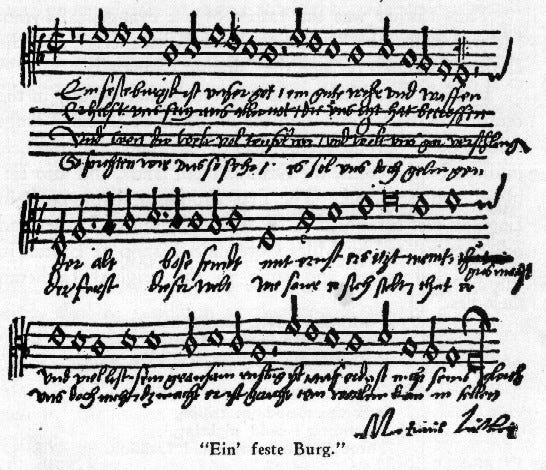
In our family worship we have been learning to sing “A Mighty Fortress is Our God.” Our standard practice is to learn a verse a time. However, a bit frustratingly the first verse of A Mighty Fortress ends with a declaration that Satan’s power is greater than our own — “On earth is not his equal.” It is of course part of the story, but it means that for a couple of weeks while we learn the song, we are ended on the very sour note of Satan’s power over us, followed by an “Amen.” In order to help the kids learn the song, I will often sing it to them in the evening before bed. Finally, the other night, I felt verse one was digested enough that I could begin preparing the kids for verse two. My son, who is very excited to read these days, sat up in bed in order to read the text and sing with me.
“Did we in our own strength confide,
Our striving would be losing.
Were not the right man on our side
The man of God’s own choosing,
Doth ask who that may be?
Christ Jesus it is he
Lord Sabbaoth his name
From age to age the same
And he must win the Battle.”
We sang these words and then I had the delight of explaining what these words mean. His joyful response: “Jesus and his army is stronger than Satan.”
“Just Jesus, buddy. He doesn’t even need an army. But we get to be a part of it.”
What joy it was to watch a smile completely take over his face as he rolls away from me in embarrassed delight.
“It’s pretty cool isn’t it?”
“Yeah.”
Stories are so powerful. Books are so powerful. Discipleship must sometimes be specific. It must sometimes be explicit and deliberate. But sometimes it doesn’t. Why do we tell stories the way we do? It is not a given that humans would be designed to be frustrated by a movie if it stopped 73% of the way through. Why can’t we just watch 65 minutes of Star Wars and then walk away satisfied? Why can’t we listen to a song and feel fulfilled even if it cuts off halfway through? It’s like we are hard-wired for an ending. Which, of course, we are. “And he must win the battle.” One of the most glorious things I do with my children is read to them. It is quality time spent with them. It is educational. It is interesting for me. And it is also discipleship—because it is training to delight in the ending. “One more chapter, Dad. It’s not that late.” That longing is not only human, but it is God-Given because the world we occupy is God-Made and he is telling his story in it and through it. And every resolution of story or melody or anything else is an echo of the creator God’s tale.
“Behold, I am making all things new.”
I believe at some point every tongue will literally confess the Jesus Christ is Lord, but until that day, in our singing and storytelling, we are confessing the same, though he is not yet named in all things. Why are “bad endings” effective? Because we contrast them against the story of hope written on our hearts. Why do we balk at a poorly told story? Because we have the Master’s story written on our hearts and know what it should be. As we read stories, and we sing songs, as we make melodies, we practice again and again—Christ is King and he is renewing all things and He must win the battle.