

During the opening week of The Tree of Life, I remember passing through glass doors with taped up notices making it clear that refunds were not going to be offered. Woe to those who saw a trailer featuring Dinosaurs, Skyscrapers, Brad Pitt and Jessica Chastain and thought they were about to see the next Summer Blockbuster.


The film certainly divided the audience in that theater. The man to my right stood up during the closing credits and told his girlfriend that it was the worst movie he’d ever seen. My friend, who sat to my left, not hearing this comment looked me in the eye to state that this was “The End of Cinema.”
He did not mean that this was the concluding chapter in the history of film, but that what Malick had done in his intensely controlled, but emotionally lush, thematically rich combination of visuals, dialogue, sound and music is the very thing that cinema was uniquely designed to do. Cinema found culmination in this work. The Tree of Life could not exist in any other form. It would not be a good book. It certainly isn’t a song. Impossible as a stage play. It does and can only ever exist as film.
Three years before the The Tree of Life was released, in 2008, I saw trailers for the Wachowski Brothers’ Speed Racer. It looked stupid. The ridiculous saturation. The cliched lines. Unintelligible flashing lights trying to pass for action. And after the profound disappointments of the Matrix sequels and V for Vendetta, I had exactly zero interest in seeing it. If I had any doubts in my resolve and had cared to read critical reviews (which overwhelmingly panned it), I would have been steeled in my opinion that this was not a film worth my time.
Here we are 18 years later, and in that intervening time, I never stopped hearing voices—often of those I respected deeply—using phrases to describe the film as a “misunderstood masterpiece” or “an avant-garde blockbuster that was too ahead of its time.” I saw Jupiter Ascending—the first film I ever hated—and read about the travesty of Cloud Atlas, which continued to affirm my opinion that The Matrix was a fluke and the Wachowskis have no actual talent for filmmaking.
But the voices didn’t stop. “The greatest racing film ever made.” “Should have won the Oscar for Editing.” “An art-house film disguised as a racing movie for kids.”
So this past week I caved. I teach high school film classes. It was Senior Ditch Day and AP exams were happening at the same time, which meant my class attendance was virtually non-existent. Why don’t we give it a go for the few stuck in the screening room with me?
I’ll say it. “I was wrong.” And I have never seen anything like Speed Racer.
In the final racing sequence of the film—amidst a blur of flashing lights, blurring lines, car sounds and flashbacks—I was surprised to recall my friend’s statement about the The Tree of Life as “the End of Cinema”. And in one particular moment during which I could no longer parse individual images—even if the film where paused, I could not tell you what I was looking at—I still had no doubt what was happening. It was emotion painted on celluloid, and in total service to the story.
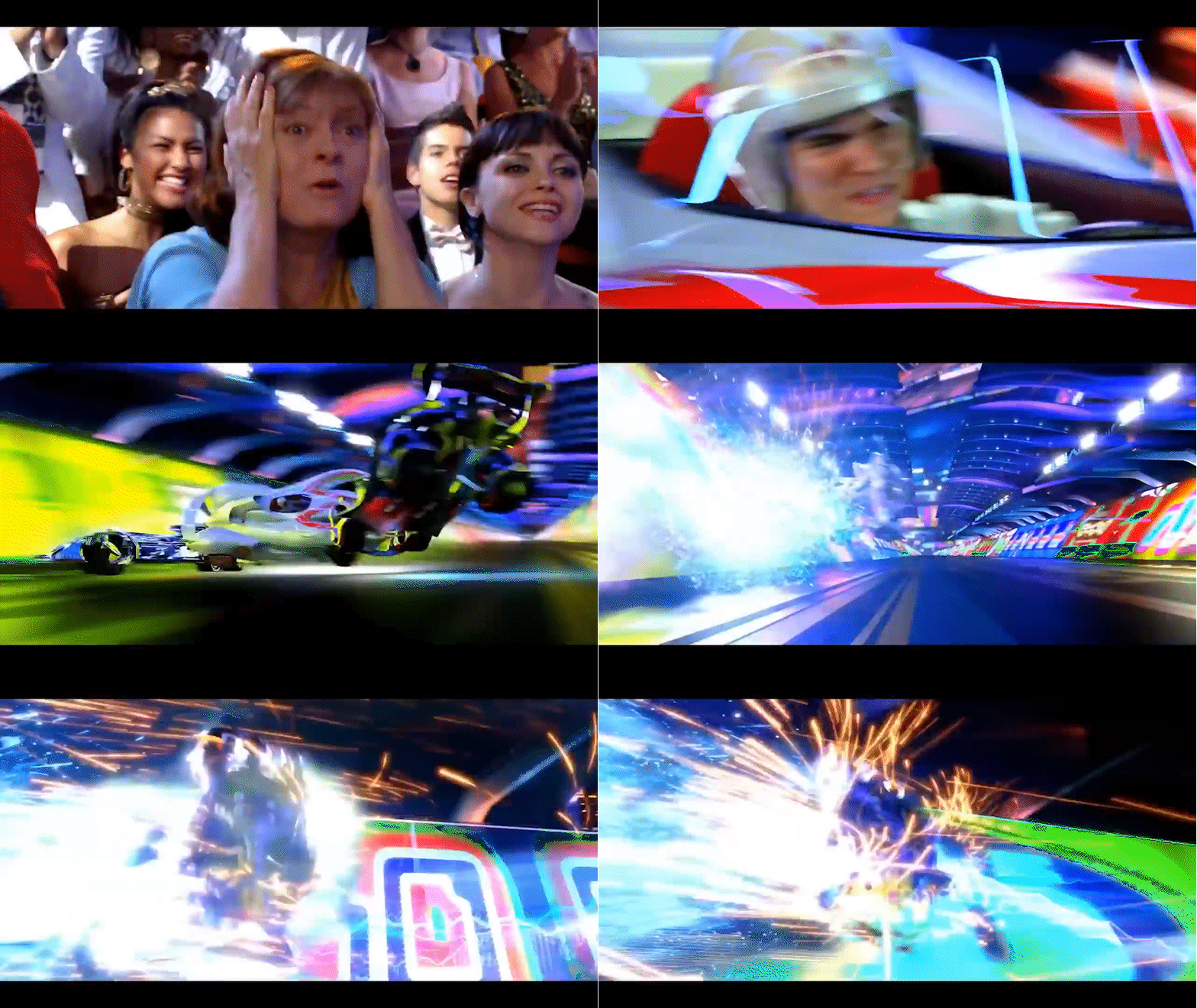
But it is not just speed and overwhelm on display. Michael Bay is another filmmaker often, and perhaps rightly derided for form over substance, but I would defy anyone to claim he isn’t a master of visual exposition. The opening of Armageddon is case in point. Several storylines kicked off with minimal dialogue and zero confusion. It may not change you, or ask anything of you, but for what it is, it is masterful. So too here we see the visual medium used in ways to create meaning in exclusively cinematic ways.
Speed Racer is not the first to utilize the techniques that it champions, but is the only film I’ve seen to make it part of it’s essential vocabulary. What other filmmakers might do once in their film with a wink and played for laughs, the Wachowskis fully commit to. Instead of shot-reverse-shot, in a film about speed, why not just whip the camera from car to car.

Is it ridiculous and over the top? Absolutely. Does it play perfectly into the momentum and emotion of the moment? Absolutely.
It’s fun to imagine the early pioneers of film being confronted with the pure cinema on display here. What would the Soviets, who theorized techniques of film editing based on the limited film processing techniques of the 1920s and 30s, say when faced with the vision of a character as a child, transitioning to a shot of the same character as an adult via the head of a character in a third location providing commentary that contextualizes both shots at the same time?

A cocktail of Pudovkin’s “Parallelism,” showing two different incidents occurring at the same time, his “Simultaneity,” which we commonly refer to cross-cutting between two scenes happening at the same time, “Leitmotif,” which repeats shots to create a cumulative meaning over the course of a film, all assembled in a comprehensive blend of Eisenstein’s “Metric,” “Rhythmic,” “Tonal,” and “Overtonal” montage.
Buckle up, Comrade.
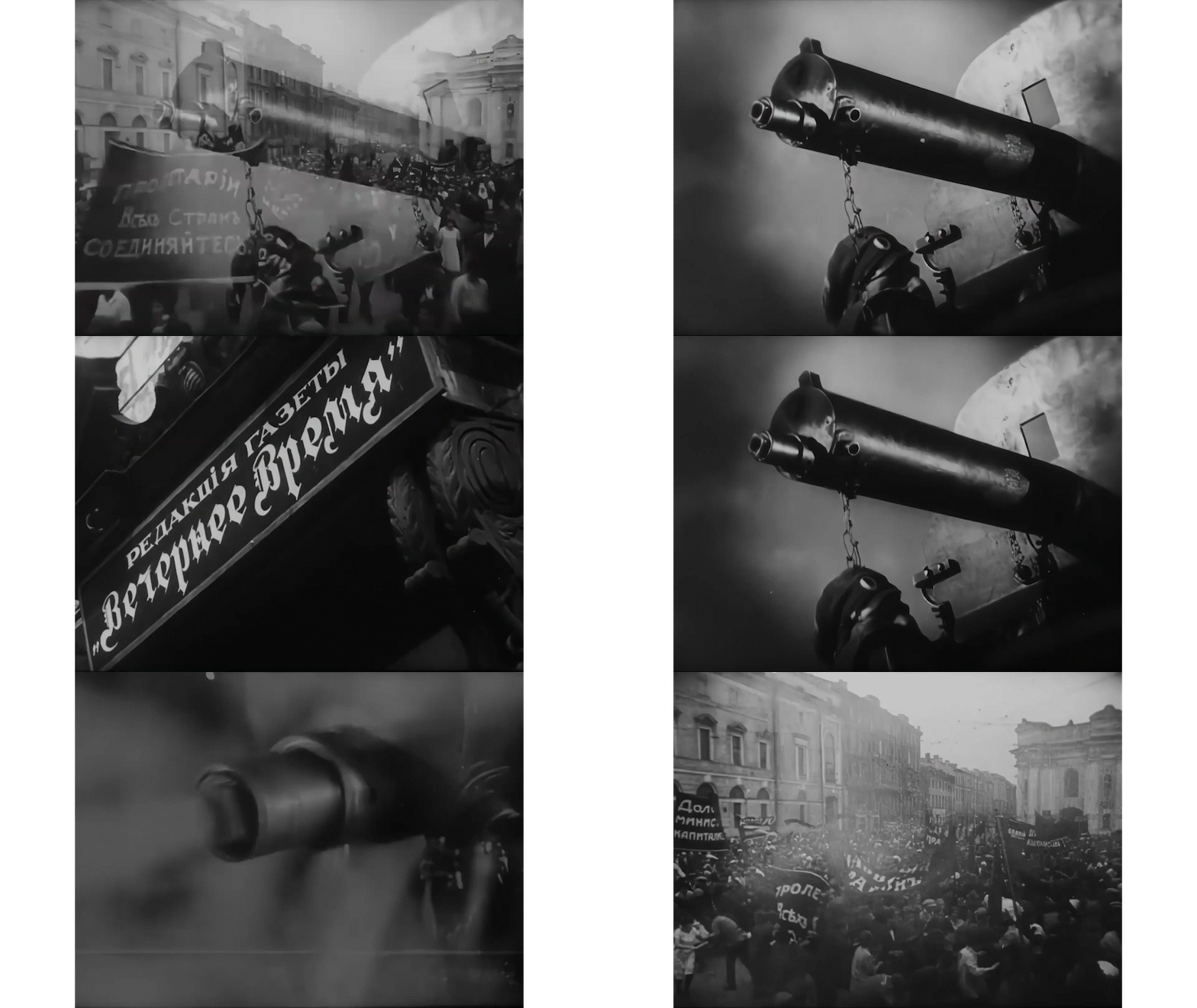
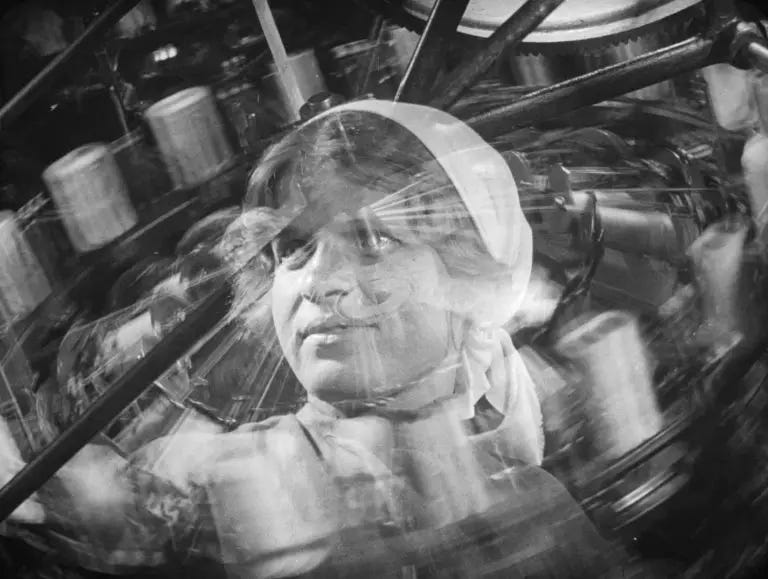
To put a fine point on it—the strength of this film is the editing. With perhaps the exception of some quieter family moments, every single shot is planned to the nth degree because of an intricate tie to the shot that comes before and the shot that comes after (or, as seen above, simultaneously!).
Lest anyone walk away from this with the impression I think The Tree of Life and Speed Racer ultimately stand on equal footing, I’ll say clearly: The Tree of Life is the sort of film you watch, rewatch, digest and walk differently afterwards. Speed Racer, well, not so much. Though it is worth saying out loud that despite the incredible play the Wachowskis use in the film, there is a genuinely sincere core, which is perhaps why the film works. Every other film I’ve seen where “MORE!” felt like the guiding principle could not take itself seriously at any point. And yet, at the center of this story is a nuclear family who cares, who expresses care, and who stick together. The filmmakers don’t seem to be winking at the camera either—”See isn’t this cute in the middle of this chaos”—and I think it serves as a landing place for minds and senses overwhelmed by the rest of the movie.
Will Speed Racer endure? I don’t know.
Is Speed Racer the “End of Cinema?” Hardly.
But I do believe Speed Racer is a place where many could rediscover the play that ought to be present in a work of art and to be inspired to continue to push the medium to create greater meaning and joy in the stories that are told.